Articles
/
The $80 Billion Wake-Up Call: Why Cash-Rich Alphabet Is Raising Capital for AI
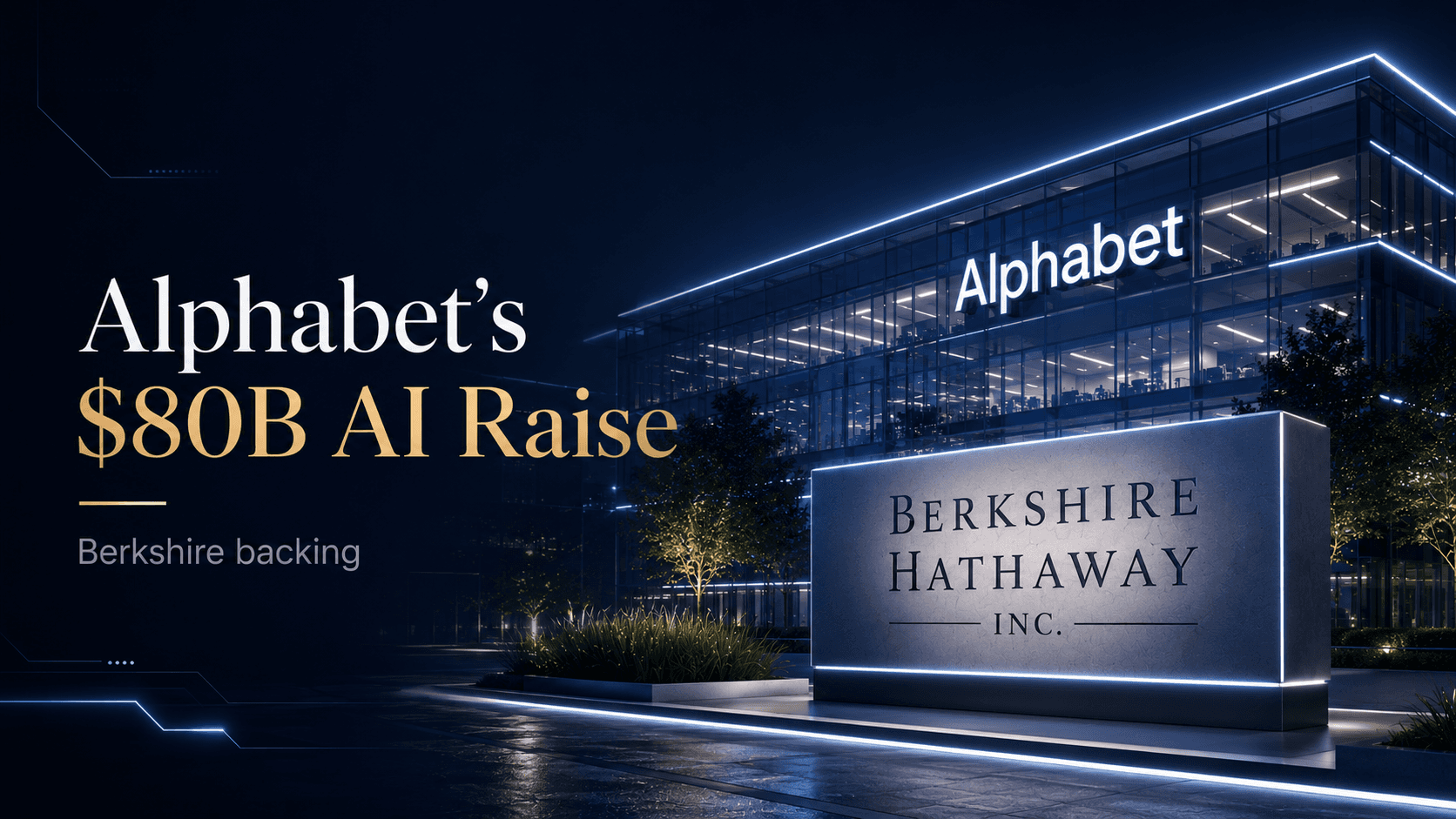
On June 1, 2026, Alphabet Inc. announced what became the largest equity capital raise in United States corporate history an $80 billion offering that was immediately oversubscribed and upsized to $84.75 billion within 24 hours. The company behind Google generated $174 billion in operating cash flow over the past twelve months. It sits on tens of billions in liquid reserves. And yet, it went to the public markets. Warren Buffett's successor at Berkshire Hathaway, Greg Abel, wrote a $10 billion check as anchor investor.
Posted at
June 08, 2026
Posted IN
Articles
This is not a story about a company in distress. This is a story about the velocity of the AI infrastructure race and what it signals for every founder, investor, and business leader operating in today's economy. If one of the most profitable companies in human history cannot fund its AI ambitions from cash flow alone, every stakeholder in the startup ecosystem needs to recalibrate their assumptions.
Industry Context: The AI Infrastructure Arms Race
The numbers are almost too large to process meaningfully. But they are real, verified, and accelerating.
Alphabet's 2026 capital expenditure guidance stands at $180 to $190 billion more than double its $91.4 billion spend in 2025, which was itself a near-doubling of its 2024 expenditure of $52.5 billion. The company's Google Cloud business saw backlog nearly double quarter-over-quarter to $460 billion, with revenues growing 63% year-on-year. Demand is not the problem. Supply is.
Alphabet is not alone in this posture. A Goldman Sachs analysis estimates that the four largest hyperscalers Alphabet, Amazon, Microsoft, and Meta are collectively on track to spend over $700 billion on AI-related capital investment in 2026, approximately 75% of which is directed squarely at AI.
Amazon leads at roughly $200 billion in projected annual capex.
Meta has guided $125 to $145 billion for 2026, nearly double its 2025 spend of $72 billion.
Microsoft is projected north of $100 billion.
By some estimates, the combined total could surpass $1 trillion by 2027.
To put the scale in context: the combined AI infrastructure spend of these four companies in 2026 exceeds the GDP of Switzerland. It represents, as Nvidia CEO Jensen Huang has repeatedly argued, the largest private infrastructure buildout in human history.
The driving factor is consistent across every company. AI demand from enterprises adopting Gemini, from consumers using AI agents, from developers building on cloud APIs is outpacing available compute supply. Google CEO Sundar Pichai told investors during the Q1 2026 earnings call that compute capacity is what keeps him up at night, and that Alphabet expects to remain supply-constrained throughout the year.
Deep Analysis: Six Insights That Change the Equation
Insight 1: When Profitable Companies Raise Equity, the Signal Is Structural Not Tactical
The conventional wisdom about equity raises is that companies do them when they need cash. Alphabet challenges that assumption at scale. Over the twelve months ending March 31, 2026, Alphabet generated $174 billion in operating cash flow. It has also raised over $85 billion in debt across six major currencies in the past year, bringing its total debt balance past $100 billion.
So why equity? The answer lies in the nature of AI infrastructure spending: it is front-loaded, long-duration, and not immediately revenue-generating. New data centers take 18 to 36 months to come online. Nvidia's next-generation Rubin-based chips and Alphabet's own TPU deployments represent commitments made today for revenue realized years from now.
Strategic Takeaway: When even the most cash-generative companies choose equity over internal funding, it signals that AI infrastructure has crossed from incremental investment into a new asset class category. Founders and investors should think about AI compute infrastructure the way a prior generation thought about telecommunications networks or interstate highways long-duration, high-stakes, winner-take-most.
Insight 2: The Berkshire Endorsement Is a Generational Signal
When Berkshire Hathaway commits $10 billion to an equity placement, the market listens. But this particular commitment carries extraordinary weight. Warren Buffett famously admitted he "screwed up" by not buying Google earlier. His successor, Greg Abel in one of his most significant capital deployments since taking over in January 2026 wrote a $10 billion check into Alphabet in the same week he deployed $6.8 billion to acquire homebuilder Taylor Morrison.
Strategic Takeaway: When the world's most disciplined capital allocator pivots to AI infrastructure, it is not a trade it is a thesis. For institutional investors still debating AI allocation frameworks, Berkshire's move effectively closes that debate. For startups operating in the AI infrastructure value chain, this is the ultimate market signal.
Insight 3: The Equity Market Structure of the Raise Reveals a Sophisticated Capital Strategy
The $84.75 billion raise was not a single transaction. It was a three-part structure:
$30 billion in underwritten public offerings.
$40 billion at-the-market program to be executed over time beginning Q3 2026.
$10 billion private placement from Berkshire Hathaway.
This structure is deliberate. The ATM program allows Alphabet to raise capital progressively at prevailing market prices, reducing the dilution impact on existing shareholders while maintaining flexibility.
Strategic Takeaway: Sophisticated founders can learn from this capital structure discipline. The question is not just "how much do we raise" but "what structure serves our long-term capital needs while preserving optionality."
Insight 4: The Supply Constraint Is the Real Story and It Creates Asymmetric Opportunity
Alphabet stated explicitly: "The company is experiencing strong demand for its AI solutions and services from enterprises and consumers, at levels that are exceeding the company's available supply."
This supply-demand imbalance has profound implications beyond Alphabet. Every enterprise that cannot get GPU time from hyperscalers is a potential customer for alternative compute providers, edge AI solutions, model optimization services, and AI-native infrastructure startups.
Strategic Takeaway: The AI compute shortage is not a problem to be solved by waiting for hyperscalers to catch up. It is a structural market gap that well-positioned startups can monetize today. The constraint is the opportunity.
Insight 5: This Is the First Time Hyperscalers Have Tapped Public Equity at This Scale for AI
Alphabet's peers have primarily funded AI infrastructure through operating cash flow and debt. Alphabet is the first of the hyperscalers to tap public equity markets at this scale specifically for AI infrastructure. It signals that management believes the pace of required investment exceeds what conventional funding mechanisms can absorb without compromising balance sheet health.
Strategic Takeaway: Investors evaluating AI companies must now model infrastructure capex as a first-order variable not a footnote. Companies that can generate returns on AI infrastructure investment faster than competitors will command significant valuation premiums.
Insight 6: The Regulatory Overhang Is Real and Alphabet Is Betting Through It
Alphabet's equity raise comes against a backdrop of ongoing antitrust proceedings. The decision to raise $84.75 billion in equity while under significant regulatory scrutiny reflects a judgment that AI leadership is more valuable than regulatory caution.
Strategic Takeaway: Regulatory uncertainty does not pause strategic investment it makes decisive action more valuable, not less. Founders and executives who delay consequential decisions while waiting for regulatory clarity often concede competitive ground they cannot recover.
Expert Perspective: What This Means for Founders and Business Leaders
For Founders, the most important lesson from Alphabet's raise is not about the dollar amountit is about conviction. Practically, this raise should shift your thinking on three dimensions:
Capital timeline compression: AI moves faster than previous technology cycles. Build runway for velocity, not just survival.
Infrastructure as competitive advantage: Access to AI compute is increasingly a determinant of startup success.
Vertical depth over horizontal breadth: The combination of domain expertise and AI capability is where asymmetric returns will be generated.
Common Mistakes to Avoid:
Assuming that because AI models are becoming commoditized, the AI opportunity is narrowing. Commoditized models make AI deployment accessible to every vertical.
Over-indexing on building proprietary AI and under-indexing on distribution and domain knowledge. The model is rarely the moat.
Treating AI infrastructure investment as a cost to minimize rather than a capability to build.
The SwiftSeed Ventures View
At SwiftSeed Ventures, we believe Alphabet's $84.75 billion raise marks a definitional moment not just for the company, but for the entire startup ecosystem.
The infrastructure layer of AI is being consolidated at a velocity and capital intensity that favors incumbents. But every previous technology infrastructure buildout created an adjacent wave of application-layer startups that generated returns equal to or greater than the infrastructure investments that enabled them. The backlog of enterprise AI demand $460 billion at Google Cloud alone represents commercial white space for startups that can deliver AI solutions faster, more accurately, and at lower cost.
The race is not between startups and hyperscalers. The race is between the founders who understand that this moment is generational and those who are still waiting for the picture to become clearer.
Conclusion: The Picture Is Already Clear
When the most profitable company in the world raises the largest equity capital offering in US corporate history to fund an AI buildout it cannot afford to lose, the strategic message is unambiguous: the AI infrastructure race has no ceiling, no pause button, and no guaranteed winners.
Alphabet's $84.75 billion raise is not a sign of excess. It is a sign of clarity. The company understands that underinvestment in AI is an existential risk and overinvestment is merely expensive. That asymmetry of outcomes should inform every capital allocation decision being made in boardrooms, venture partnerships, and founder strategy sessions today.
The $80 billion wake-up call has been placed. The question is not whether you heard it. The question is what you do next.
This is not a story about a company in distress. This is a story about the velocity of the AI infrastructure race and what it signals for every founder, investor, and business leader operating in today's economy. If one of the most profitable companies in human history cannot fund its AI ambitions from cash flow alone, every stakeholder in the startup ecosystem needs to recalibrate their assumptions.
Industry Context: The AI Infrastructure Arms Race
The numbers are almost too large to process meaningfully. But they are real, verified, and accelerating.
Alphabet's 2026 capital expenditure guidance stands at $180 to $190 billion more than double its $91.4 billion spend in 2025, which was itself a near-doubling of its 2024 expenditure of $52.5 billion. The company's Google Cloud business saw backlog nearly double quarter-over-quarter to $460 billion, with revenues growing 63% year-on-year. Demand is not the problem. Supply is.
Alphabet is not alone in this posture. A Goldman Sachs analysis estimates that the four largest hyperscalers Alphabet, Amazon, Microsoft, and Meta are collectively on track to spend over $700 billion on AI-related capital investment in 2026, approximately 75% of which is directed squarely at AI.
Amazon leads at roughly $200 billion in projected annual capex.
Meta has guided $125 to $145 billion for 2026, nearly double its 2025 spend of $72 billion.
Microsoft is projected north of $100 billion.
By some estimates, the combined total could surpass $1 trillion by 2027.
To put the scale in context: the combined AI infrastructure spend of these four companies in 2026 exceeds the GDP of Switzerland. It represents, as Nvidia CEO Jensen Huang has repeatedly argued, the largest private infrastructure buildout in human history.
The driving factor is consistent across every company. AI demand from enterprises adopting Gemini, from consumers using AI agents, from developers building on cloud APIs is outpacing available compute supply. Google CEO Sundar Pichai told investors during the Q1 2026 earnings call that compute capacity is what keeps him up at night, and that Alphabet expects to remain supply-constrained throughout the year.
Deep Analysis: Six Insights That Change the Equation
Insight 1: When Profitable Companies Raise Equity, the Signal Is Structural Not Tactical
The conventional wisdom about equity raises is that companies do them when they need cash. Alphabet challenges that assumption at scale. Over the twelve months ending March 31, 2026, Alphabet generated $174 billion in operating cash flow. It has also raised over $85 billion in debt across six major currencies in the past year, bringing its total debt balance past $100 billion.
So why equity? The answer lies in the nature of AI infrastructure spending: it is front-loaded, long-duration, and not immediately revenue-generating. New data centers take 18 to 36 months to come online. Nvidia's next-generation Rubin-based chips and Alphabet's own TPU deployments represent commitments made today for revenue realized years from now.
Strategic Takeaway: When even the most cash-generative companies choose equity over internal funding, it signals that AI infrastructure has crossed from incremental investment into a new asset class category. Founders and investors should think about AI compute infrastructure the way a prior generation thought about telecommunications networks or interstate highways long-duration, high-stakes, winner-take-most.
Insight 2: The Berkshire Endorsement Is a Generational Signal
When Berkshire Hathaway commits $10 billion to an equity placement, the market listens. But this particular commitment carries extraordinary weight. Warren Buffett famously admitted he "screwed up" by not buying Google earlier. His successor, Greg Abel in one of his most significant capital deployments since taking over in January 2026 wrote a $10 billion check into Alphabet in the same week he deployed $6.8 billion to acquire homebuilder Taylor Morrison.
Strategic Takeaway: When the world's most disciplined capital allocator pivots to AI infrastructure, it is not a trade it is a thesis. For institutional investors still debating AI allocation frameworks, Berkshire's move effectively closes that debate. For startups operating in the AI infrastructure value chain, this is the ultimate market signal.
Insight 3: The Equity Market Structure of the Raise Reveals a Sophisticated Capital Strategy
The $84.75 billion raise was not a single transaction. It was a three-part structure:
$30 billion in underwritten public offerings.
$40 billion at-the-market program to be executed over time beginning Q3 2026.
$10 billion private placement from Berkshire Hathaway.
This structure is deliberate. The ATM program allows Alphabet to raise capital progressively at prevailing market prices, reducing the dilution impact on existing shareholders while maintaining flexibility.
Strategic Takeaway: Sophisticated founders can learn from this capital structure discipline. The question is not just "how much do we raise" but "what structure serves our long-term capital needs while preserving optionality."
Insight 4: The Supply Constraint Is the Real Story and It Creates Asymmetric Opportunity
Alphabet stated explicitly: "The company is experiencing strong demand for its AI solutions and services from enterprises and consumers, at levels that are exceeding the company's available supply."
This supply-demand imbalance has profound implications beyond Alphabet. Every enterprise that cannot get GPU time from hyperscalers is a potential customer for alternative compute providers, edge AI solutions, model optimization services, and AI-native infrastructure startups.
Strategic Takeaway: The AI compute shortage is not a problem to be solved by waiting for hyperscalers to catch up. It is a structural market gap that well-positioned startups can monetize today. The constraint is the opportunity.
Insight 5: This Is the First Time Hyperscalers Have Tapped Public Equity at This Scale for AI
Alphabet's peers have primarily funded AI infrastructure through operating cash flow and debt. Alphabet is the first of the hyperscalers to tap public equity markets at this scale specifically for AI infrastructure. It signals that management believes the pace of required investment exceeds what conventional funding mechanisms can absorb without compromising balance sheet health.
Strategic Takeaway: Investors evaluating AI companies must now model infrastructure capex as a first-order variable not a footnote. Companies that can generate returns on AI infrastructure investment faster than competitors will command significant valuation premiums.
Insight 6: The Regulatory Overhang Is Real and Alphabet Is Betting Through It
Alphabet's equity raise comes against a backdrop of ongoing antitrust proceedings. The decision to raise $84.75 billion in equity while under significant regulatory scrutiny reflects a judgment that AI leadership is more valuable than regulatory caution.
Strategic Takeaway: Regulatory uncertainty does not pause strategic investment it makes decisive action more valuable, not less. Founders and executives who delay consequential decisions while waiting for regulatory clarity often concede competitive ground they cannot recover.
Expert Perspective: What This Means for Founders and Business Leaders
For Founders, the most important lesson from Alphabet's raise is not about the dollar amountit is about conviction. Practically, this raise should shift your thinking on three dimensions:
Capital timeline compression: AI moves faster than previous technology cycles. Build runway for velocity, not just survival.
Infrastructure as competitive advantage: Access to AI compute is increasingly a determinant of startup success.
Vertical depth over horizontal breadth: The combination of domain expertise and AI capability is where asymmetric returns will be generated.
Common Mistakes to Avoid:
Assuming that because AI models are becoming commoditized, the AI opportunity is narrowing. Commoditized models make AI deployment accessible to every vertical.
Over-indexing on building proprietary AI and under-indexing on distribution and domain knowledge. The model is rarely the moat.
Treating AI infrastructure investment as a cost to minimize rather than a capability to build.
The SwiftSeed Ventures View
At SwiftSeed Ventures, we believe Alphabet's $84.75 billion raise marks a definitional moment not just for the company, but for the entire startup ecosystem.
The infrastructure layer of AI is being consolidated at a velocity and capital intensity that favors incumbents. But every previous technology infrastructure buildout created an adjacent wave of application-layer startups that generated returns equal to or greater than the infrastructure investments that enabled them. The backlog of enterprise AI demand $460 billion at Google Cloud alone represents commercial white space for startups that can deliver AI solutions faster, more accurately, and at lower cost.
The race is not between startups and hyperscalers. The race is between the founders who understand that this moment is generational and those who are still waiting for the picture to become clearer.
Conclusion: The Picture Is Already Clear
When the most profitable company in the world raises the largest equity capital offering in US corporate history to fund an AI buildout it cannot afford to lose, the strategic message is unambiguous: the AI infrastructure race has no ceiling, no pause button, and no guaranteed winners.
Alphabet's $84.75 billion raise is not a sign of excess. It is a sign of clarity. The company understands that underinvestment in AI is an existential risk and overinvestment is merely expensive. That asymmetry of outcomes should inform every capital allocation decision being made in boardrooms, venture partnerships, and founder strategy sessions today.
The $80 billion wake-up call has been placed. The question is not whether you heard it. The question is what you do next.