Articles
/
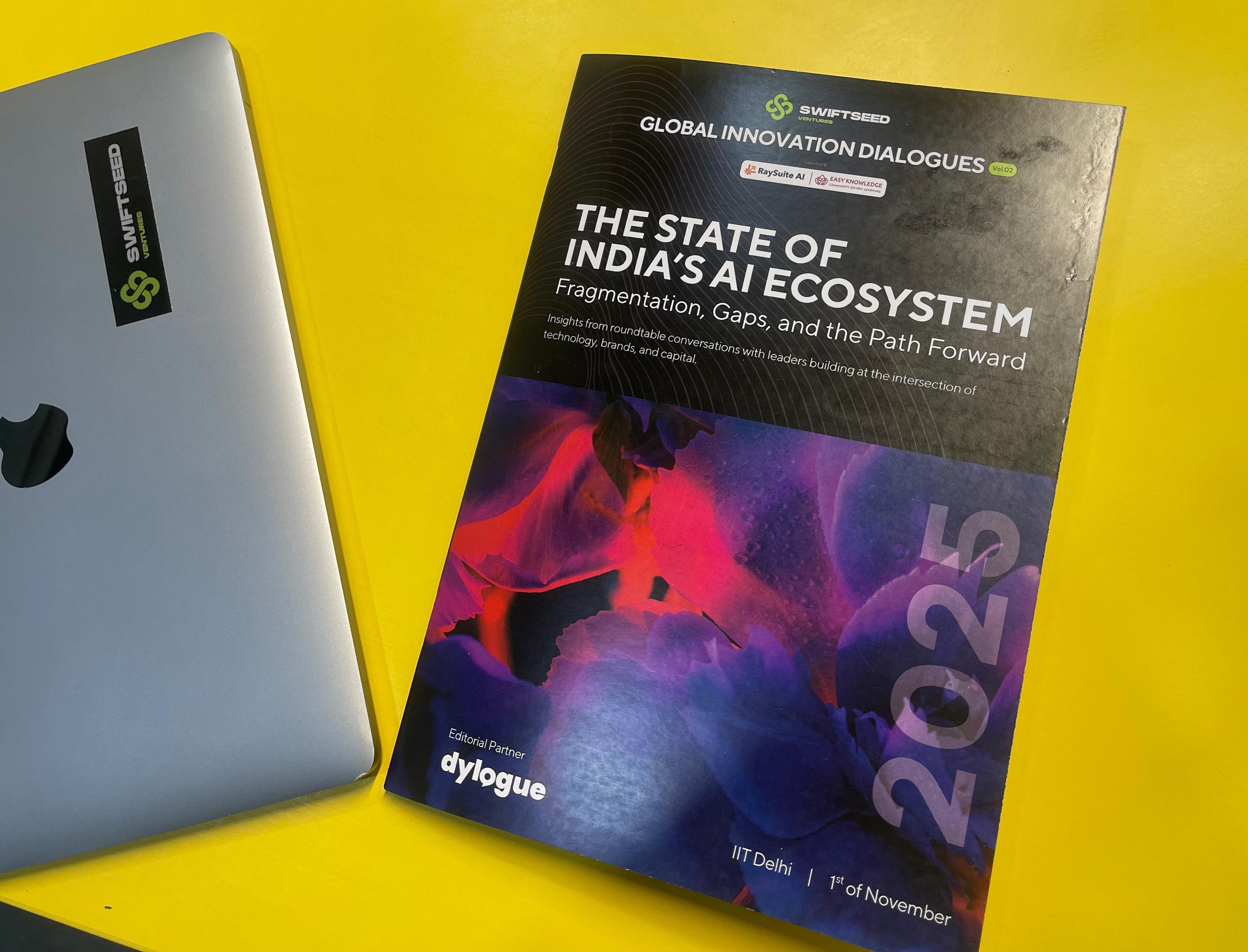
The State of India's AI Ecosystem: Fragmentation, Gaps, and the Path Forward
This article summarizes the report's key findings, challenges, and recommendations, offering a roadmap for stakeholders to bridge these gaps. Whether you're a founder building AI solutions, an investor evaluating opportunities, or a corporate leader eyeing adoption, these insights provide a clear path to alignment and growth.
Posted at
Dec 31, 2025
Posted IN
Reports
India's AI landscape is buzzing with energy, hundreds of startups emerging each year, significant venture capital inflows, global tech giants like Google, Microsoft, and Amazon setting up AI centres, and academic institutions pushing cutting-edge research. Yet, despite this vibrant activity, the ecosystem remains fragmented and misaligned.
This is the central insight from the second volume of the Global Innovation Dialogues, a thoughtful roundtable convened at IIT Delhi on November 1st. Over 30 leaders—founders, investors, corporate executives, and academics—came together to diagnose why India's AI potential isn't translating into defensible, large-scale impact. The barriers, they concluded, are not primarily technological but organizational and strategic.
The deepest issues stem from a lack of shared understanding about what problems AI should solve, inconsistent ways to evaluate its long-term defensibility, missing connections between key players, and undefined standards for data governance and ethical use.
The Core Challenge: An Alignment Gap, Not a Capability Gap
India has the talent, infrastructure, and ambition. What's missing is orchestration—a common framework to guide funding, building, and responsible deployment of AI.
This misalignment creates real costs. Startups often develop global, cloud-based products while enterprises demand on-premise solutions for data sovereignty. Investors chase flashy models, but founders prioritize features, overlooking data as the true moat. Academic breakthroughs rarely reach the market due to absent commercialization pathways. And in regulated sectors, nearly 90% of corporates flag data sovereignty as their biggest adoption barrier.
Five Powerful Shifts Reshaping India's AI Strategy
The discussions highlighted transformative forces at play.
First, foundational AI models are rapidly becoming commodities. Open-source options now rival proprietary ones in performance, shifting competition to proprietary datasets, ethical governance, and deployment methods like on-premise or federated learning.
Second, data quality is emerging as the bedrock of trustworthy AI. Poor or biased data leads to hallucinations and unfair outcomes—especially critical in a diverse nation like India.
Third, hyper-personalization in marketing has become operationally viable. Tools can now automatically extract viral clips from long videos, generate user-created-style content in seconds, create scalable synthetic brand ambassadors, and enable real-time contextual advertising.
Fourth, on-premise AI is no longer optional for enterprises—it's essential for compliance in finance, healthcare, and government sectors where data must stay sovereign.
Finally, AI acts as a horizontal enabler, transforming multiple industries simultaneously—from diagnostics in healthcare to fraud detection in fintech and predictive maintenance in manufacturing.
A Leadership Choice: Augmentation Over Replacement
Leaders overwhelmingly view AI as an augmentation tool that boosts human productivity, rather than a pure replacement. Framing it this way accelerates adoption, builds employee engagement, and delivers faster returns.
The Path Ahead: Collaboration and Purpose-Driven Innovation
Sustainable success will come from purpose-driven approaches: solving clearly defined, high-impact problems with proprietary data advantages and sovereign deployment options. Greater convergence between founders, investors, corporates, and academia is urgently needed—through pilots, shared pipelines, and cross-sector initiatives.
As one participant powerfully stated: "The biggest risk for India's AI ecosystem is not falling behind globally—it is failing to align internally."
To dive deeper into these insights, quotes from participants, and a practical 12-month roadmap for alignment, download the full Global Innovation Dialogues Vol.02 report here: Download the Report (or contact work@swiftseed.xyz for a copy).
This report, supported by SwiftSeed Ventures, RaySuite AI, and Easy Knowledge, with editorial partnership from Dylogue, offers an invaluable blueprint for turning India's AI promise into reality. Don't miss it.
India's AI landscape is buzzing with energy, hundreds of startups emerging each year, significant venture capital inflows, global tech giants like Google, Microsoft, and Amazon setting up AI centres, and academic institutions pushing cutting-edge research. Yet, despite this vibrant activity, the ecosystem remains fragmented and misaligned.
This is the central insight from the second volume of the Global Innovation Dialogues, a thoughtful roundtable convened at IIT Delhi on November 1st. Over 30 leaders—founders, investors, corporate executives, and academics—came together to diagnose why India's AI potential isn't translating into defensible, large-scale impact. The barriers, they concluded, are not primarily technological but organizational and strategic.
The deepest issues stem from a lack of shared understanding about what problems AI should solve, inconsistent ways to evaluate its long-term defensibility, missing connections between key players, and undefined standards for data governance and ethical use.
The Core Challenge: An Alignment Gap, Not a Capability Gap
India has the talent, infrastructure, and ambition. What's missing is orchestration—a common framework to guide funding, building, and responsible deployment of AI.
This misalignment creates real costs. Startups often develop global, cloud-based products while enterprises demand on-premise solutions for data sovereignty. Investors chase flashy models, but founders prioritize features, overlooking data as the true moat. Academic breakthroughs rarely reach the market due to absent commercialization pathways. And in regulated sectors, nearly 90% of corporates flag data sovereignty as their biggest adoption barrier.
Five Powerful Shifts Reshaping India's AI Strategy
The discussions highlighted transformative forces at play.
First, foundational AI models are rapidly becoming commodities. Open-source options now rival proprietary ones in performance, shifting competition to proprietary datasets, ethical governance, and deployment methods like on-premise or federated learning.
Second, data quality is emerging as the bedrock of trustworthy AI. Poor or biased data leads to hallucinations and unfair outcomes—especially critical in a diverse nation like India.
Third, hyper-personalization in marketing has become operationally viable. Tools can now automatically extract viral clips from long videos, generate user-created-style content in seconds, create scalable synthetic brand ambassadors, and enable real-time contextual advertising.
Fourth, on-premise AI is no longer optional for enterprises—it's essential for compliance in finance, healthcare, and government sectors where data must stay sovereign.
Finally, AI acts as a horizontal enabler, transforming multiple industries simultaneously—from diagnostics in healthcare to fraud detection in fintech and predictive maintenance in manufacturing.
A Leadership Choice: Augmentation Over Replacement
Leaders overwhelmingly view AI as an augmentation tool that boosts human productivity, rather than a pure replacement. Framing it this way accelerates adoption, builds employee engagement, and delivers faster returns.
The Path Ahead: Collaboration and Purpose-Driven Innovation
Sustainable success will come from purpose-driven approaches: solving clearly defined, high-impact problems with proprietary data advantages and sovereign deployment options. Greater convergence between founders, investors, corporates, and academia is urgently needed—through pilots, shared pipelines, and cross-sector initiatives.
As one participant powerfully stated: "The biggest risk for India's AI ecosystem is not falling behind globally—it is failing to align internally."
To dive deeper into these insights, quotes from participants, and a practical 12-month roadmap for alignment, download the full Global Innovation Dialogues Vol.02 report here: Download the Report (or contact work@swiftseed.xyz for a copy).
This report, supported by SwiftSeed Ventures, RaySuite AI, and Easy Knowledge, with editorial partnership from Dylogue, offers an invaluable blueprint for turning India's AI promise into reality. Don't miss it.